
Five Tips for Selecting the Right Shearing Machine
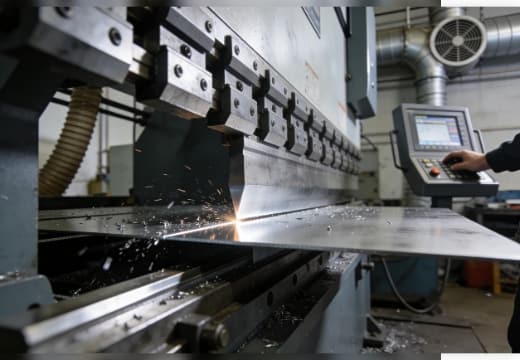
With the advancement of our economy, China's heavy industry has also experienced rapid development. Machine tools such as shearing machines, bending machines, and punching presses have become indispensable equipment across various sectors. These machines range in price from tens of thousands to hundreds of thousands, or even millions of yuan. How to procure satisfactory products has thus become a challenge. Drawing upon years of industry experience, Nantong Suleiman Machinery Co., Ltd. offers the following insights for reference.
Machinery such as shearing machines, bending machines, and punching presses become fixed assets upon purchase. Therefore, particular attention must be paid to product quality during selection. High-quality equipment not only boasts a longer service life and higher operational efficiency but also incurs minimal depreciation as a fixed asset investment. Buyers should not prioritise short-term price differences over selecting substandard equipment! During the selection process, the following points should be considered:
1. First, determine the type of metal plate to be cut, along with the maximum processing thickness and length. These specifications will help identify the appropriate machine model. Should uncertainty arise, consult the manufacturer for recommendations. Crucially, factor in future expansion needs when selecting the model, allowing for some capacity margin. Once the model is confirmed, investigate the operational performance, quality, and particularly the after-sales service of machines already in use locally.
2. Identify manufacturers producing the desired machine model. This step is often overlooked, as manufacturers typically claim specialisation in their advertised models. In reality, different manufacturers frequently produce distinct variants, often sourcing various models through cross-stocking arrangements. This practice compromises the reliability of after-sales support. We recommend selecting Nantong Suleiman Machinery Co., Ltd. Our company integrates production and sales, independently developing and manufacturing various models of shearing machines. After-sales services including installation guidance, usage instruction, maintenance, and repairs are personally conducted by our engineers on-site, ensuring quality assurance.
3. After contacting multiple machinery manufacturers and obtaining pricing, specifications, payment terms, and delivery methods, the crucial step is selecting the supplier. Typically, eliminate the highest and lowest quotes before choosing a reputable manufacturer. This approach ensures favourable value for money while safeguarding quality and after-sales support.
4. Subsequently, proceed with contract signing, deposit payment, and arrange for either cash-on-delivery or payment upon collection. Where feasible, a factory visit is advisable. Following these steps generally ensures the acquisition of a satisfactory product.
5. Finally, an overview of common plate shearing machine classifications is provided to facilitate rapid identification of the required type based on specific production needs. Plate shearing machines fall under the category of linear shearing equipment, primarily employed for trimming straight edges on metal sheets of various dimensions. They find extensive application across industrial sectors including steel rolling, automotive, aerospace, shipbuilding, tractor manufacturing, bridge construction, electrical appliances, instrumentation, boilers, and pressure vessels.
Shearing machines encompass numerous varieties, categorised by their process function and structural type as follows:
1. Flat-blade shearing machines: Offer superior shearing quality with minimal distortion, though they require substantial shearing force and consume significant energy. Most are mechanically driven. The upper and lower blades are parallel, commonly used for hot shearing of hot-rolled billets and slabs in steel mills. They can be further categorised by shearing method into top-cutting and bottom-cutting types.
2. Oblique-blade shears: The upper and lower blades form an angle, typically with the upper blade inclined at 1° to 6°. Shearing force is lower than in parallel-blade shears, significantly reducing motor power and overall machine weight. This type is most widely used in practice, with most manufacturers producing these shears. They are categorised by blade carriage movement into guillotine shears and swing shears; by main drive system into hydraulic and mechanical transmission types.
III. Multi-purpose shears:
1. Bending-shearing machines: Capable of performing both shearing and bending operations on a single machine.
2. Combined punch-shear machines: Suitable for both plate shearing and profile cutting, primarily used in blanking operations.
IV. Specialised shears: Often integrated with other equipment to fulfil specific functions
1. Sheet Uncoiling Line Shears: Employed on sheet uncoiling and levelling lines, these high-speed shears are designed to meet rapid cutting demands of production lines. Hydraulic high-speed shears are common on thick sheet lines, while pneumatic shears are typically fitted on thin sheet lines. Flying shears are integrated into high-speed lines for continuous, efficient production.
2. Structural steel production line shears: Primarily employed in automatic production lines for angle steel and H-section steel to execute cutting operations.
3. Cold-forming line shears: Specialised shearing equipment configured for production lines such as automotive longitudinal beam cold-forming lines, vehicle side panel production lines, and colour-coated steel sheet forming lines.
Ready to Invest in Reliable Machine Tools?
Get a free, personalized equipment recommendation from our engineers based on your material, thickness, and production goals.
✅ Request Your Quote & Specification Sheet Today

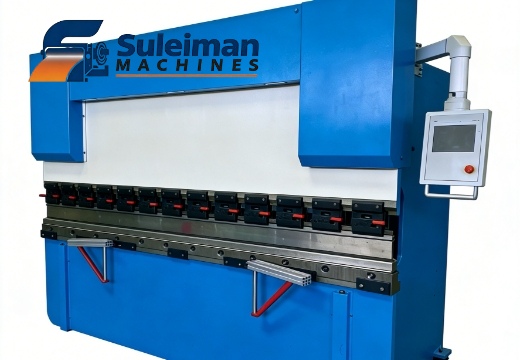 Bending on a Budget: Why the Torsion Bar CNC Press Brake is Still the ROI King
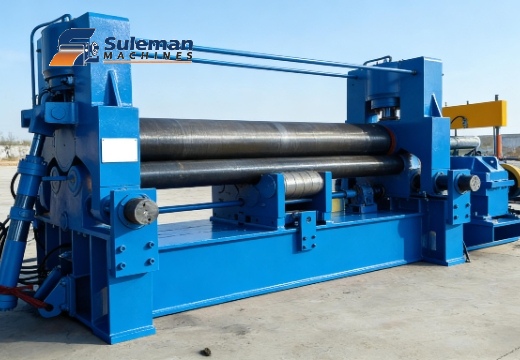 Why Wind Power Projects Demand "Universal" 3-Roll Plate Rollers
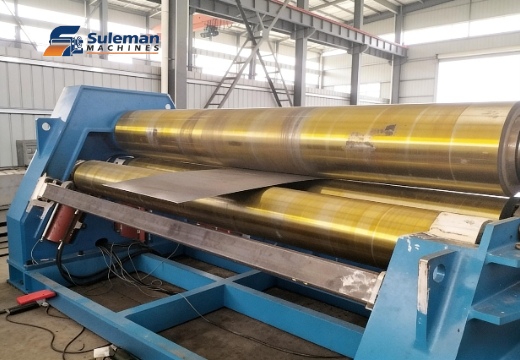 he "Max Thickness" Trap: Why Your 20mm Plate Roller is Failing Your 16mm Jobs